Whatsapp: + 84-33769-1322 Email: info@maquagroup.com
Hard-Earned Lessons from Importing Raw Materials for Agarbatti Production in India: An Insider’s Perspective
India’s agarbatti industry—often called the “Black Diamond” market—depends on a complex global raw material supply chain. This article reveals key lessons on quality control, supplier due diligence, tariff strategy, and landed cost optimization when importing incense production materials. A strategic guide for entrepreneurs seeking to build a resilient and profitable agarbatti supply chain.
AGARBATTI MAQUA GROUP
8/8/20253 min read
In the spiritual consumer goods economy, India is not only a major consumer but also the largest incense manufacturing hub in the world. Yet entering the raw material supply chain—often referred to within the industry as the “Black Diamond” sector—is a complex challenge involving international strategy and operational management.
For a startup, this is not simply a buying-and-selling activity; it is a battle of cost optimization and quality control at the source.
Below are strategic insights and hard-earned lessons for executives who aim to master this supply chain.
1. Lesson One: The Quality Trap and Marginal Cost
The difference between an amateur manufacturer and an industry expert lies in efficiency thinking. Many companies, such as Chandrama Agarbatti, have abandoned domestic supply and turned to direct imports because of one critical technical metric: Counting (the number of incense sticks produced per kilogram of powder).
Market reality shows that adulterated powder (मिलावट) often appears cheaper and heavier but significantly reduces production efficiency.
While pure imported powder can produce 1,100+ sticks per kg, adulterated powder typically yields only around 900 sticks.
Strategic analysis:
Although imported powder may have a higher price per kilogram, the marginal cost per finished incense stick becomes significantly lower due to higher counting efficiency.
This hidden cost advantage is often overlooked by newcomers who focus only on the initial purchase price.
“To produce the best product, you must source the best raw materials from their origin.”
Strategic Comparison: Domestic Procurement vs. Direct Import
CriteriaDomestic ProcurementDirect ImportPurityLow (often mixed to increase weight)High (controlled at origin)Efficiency (Counting)Low (~900 sticks/kg)Optimal (1100+ sticks/kg)Customs DutiesNone0% – 25% depending on productPayment RiskLowMedium (requires international credibility)ScalabilityLimitedVery high
2. Lesson Two: The Power of Data and Supplier Due Diligence
In international trade, intuition is the enemy of profit. Investing around 1.5 lakh INR in market intelligence data is not an expense—it is risk insurance.
Such data enables deep supplier due diligence, including:
Identifying competitors’ actual purchase prices and shipment frequency
Verifying the reliability and capacity of Top 5–10 global suppliers
Avoiding the catastrophic risk of receiving worthless materials instead of goods
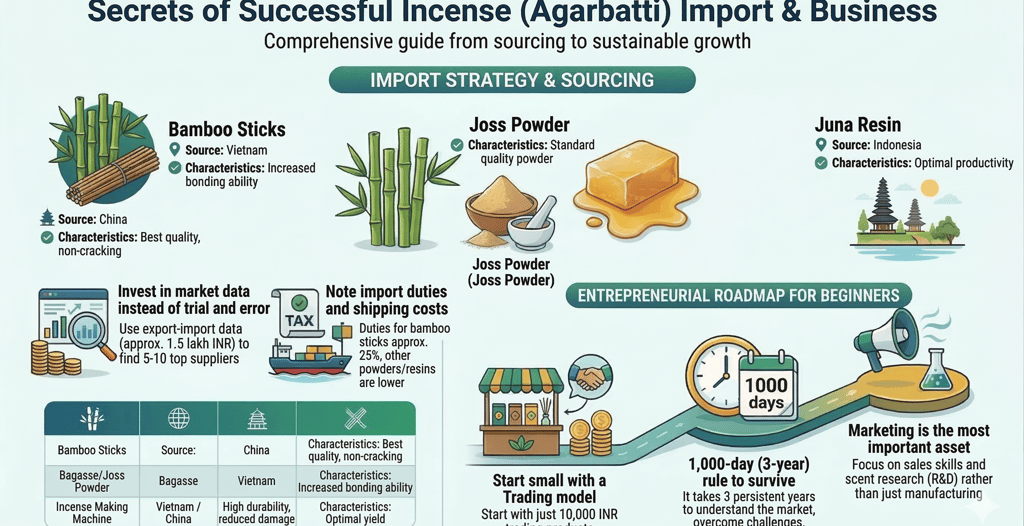
Strategic Supply Sources
Vietnam: Machinery (high durability), Joss Powder (adhesive powder), and T1 powder
China: Highly uniform bamboo sticks
Indonesia: Natural resin (Jhoona)
3. Lesson Three: The Lean Start-Up Strategy and the 1,000-Day Rule
A paradox in this industry is clear: the more capital you invest in machinery before understanding the market, the higher your risk of failure.
A true professional needs at least 1,000 days (around three years) to fully understand operational realities.
Capital strategy:
Adopt the Lean Start-up model.
Begin with trading or small-scale production using purchased raw materials to understand customer demand. Only after securing stable market demand and cash flow should you invest in expensive imported machinery.
After 1,000 days, your most valuable asset will not be factories or machines—but market knowledge and strategic partnerships.
4. Lesson Four: Tariff Structure and Landed Cost Optimization
Understanding customs tariffs is essential for calculating accurate landed costs.
Based on market practice, the tax structure is clearly differentiated:
Bamboo sticks: High duty (around 25%) — the largest cost barrier
Strategic raw materials (T1 powder, Joss powder, Jhoona resin): Customs duty exempt, only subject to IGST
Machinery: Often low duty or IGST only
Machinery imported from Vietnam is particularly valued for durability and advanced engineering, often outperforming low-quality domestic copies.
5. Lesson Five: Building Payment Credibility and Managing Capital Flow
International payment terms reflect a company’s business maturity.
Early stage:
Most suppliers require 30% advance and 70% payment before shipment.
Professional stage:
Once trust is established with top-tier suppliers, companies should negotiate 100% DP (Documents against Payment).
This payment structure greatly improves working capital optimization, allowing companies to pay only when shipping documents reach the bank.
6. Strategic Vision: Marketing Creates Assets, Quality Builds Foundations
Importing high-quality raw materials and durable machinery from Vietnam is only a necessary condition, not the final competitive advantage.
To escape pure price competition, companies must build a brand.
In the incense industry, success lies in the art of fragrance blending—balancing top notes and base notes.
While high-quality raw materials ensure consistency, strong marketing transforms products into assets.
Premium brands such as 24 Carat and Naivedya demonstrate this clearly:
they do not sell incense—they sell purity and a distinctive spiritual experience.
Conclusion: Experience Is the Only True Competitive Advantage
In this traditional industry, success does not come from luck or the cheapest supply source.
It comes from the discipline to navigate the 1,000-day journey of mastering the supply chain, from understanding tariff structures to optimizing marginal cost through the Counting index.
The real question for business leaders is simple:
In a market where anyone can purchase machines, does your competitive advantage lie in product price—or in deep mastery of every link in the global supply chain?
Contact information
MAQUA GROUP Co., Ltd.
Address: 36 Trần Tử Bình , Nghĩa Đô, Hanoi, Vietnam
whatsApp: + 84-33769-1322
Email : info@maquagroup.com
Website : maquagroup.com